Most people think reading a Kundli for marriage means looking for a single "good" or "bad" sign.
It doesn't work that way.
Professional astrologers don't make marriage predictions from one planet, one dosha, or one yoga. They study patterns across the entire birth chart before forming an opinion.
That's why two people with the same Mangal Dosha can have completely different marriage experiences.
This guide explains, in simple language, how a Kundli is actually read for marriage. You won't need astrology knowledge to follow along, and you'll also learn why relying on isolated internet rules often creates unnecessary fear.
- Marriage analysis is never based on one placement
- The 7th house is important, but it isn't the only factor
- Planetary strength matters more than labels
- Timing and compatibility both influence interpretation
- A full Kundli always provides more context than individual yogas or dosha names
What Is a Marriage Kundli?
Many people hear terms like "marriage Kundli" or "marriage horoscope" and imagine it's a special chart created only for relationships.
It isn't.
A marriage Kundli is simply your birth chart viewed from the perspective of relationships, commitment, partnership, and long-term compatibility.
The same birth chart used for career, health, education, or finances is also used for marriage analysis. The difference lies in which houses, planets, and combinations receive greater attention.
Instead of asking "Will I get married?" astrologers usually ask more specific questions:
- How does this person approach relationships?
- What kind of partner suits them?
- Is marriage likely to happen smoothly or after delays?
- What strengths and challenges appear in partnerships?
Those questions require looking at the chart as a whole rather than searching for a single positive or negative sign.
A Kundli is like a complete map. Looking at only one planet is similar to judging an entire city after seeing a single street.
Step 1: Start with the 7th House
The first place most astrologers examine is the 7th house.
This house traditionally represents:
- Marriage
- Long-term partnerships
- Spouse
- Commitment
- Legal unions
Because of this, many online articles claim that the 7th house alone determines your marriage. That is an oversimplification.
A strong 7th house does not automatically guarantee an easy marriage, and a challenging 7th house does not automatically indicate failure.
Astrologers study several things here:
- Which zodiac sign occupies the house
- Whether planets are placed inside it
- Benefic or challenging influences
- The condition of its ruling planet
Each observation adds context rather than producing an immediate conclusion.
My 7th house has Saturn, so marriage is impossible.
Saturn often represents patience, maturity, responsibility, or delayed results — not permanent denial. The overall chart determines how that influence actually unfolds.
Step 2: Examine the 7th House Lord
After studying the house itself, astrologers look at its ruling planet, often called the 7th house lord.
Think of the house as a home. The house lord is the owner of that home. Even if the house appears strong, the owner's condition also matters.
Questions commonly asked include:
- Which house is the ruler placed in?
- Is it comfortable there?
- Is it strengthened or weakened?
- Does it receive supportive aspects?
The answers help explain how relationship energy may express itself throughout life.
This is one reason astrology cannot be reduced to simple checklists. Two charts may have identical 7th houses but completely different 7th house lords, leading to very different interpretations.
Many beginners focus only on houses. Professional astrologers spend just as much time understanding the planets that rule those houses.
Step 3: Understand Venus and Jupiter
Marriage analysis isn't complete without studying relationship planets.
For most charts, Venus is associated with love, attraction, harmony, affection, and emotional connection. Jupiter often represents wisdom, guidance, stability, growth, and long-term values within relationships.
Rather than asking whether these planets are "good" or "bad," astrologers ask:
- Are they comfortable in their placements?
- How do they interact with other planets?
- Do they support healthy partnerships?
Strong relationship indicators often come from balance — not perfection. A chart rarely needs every planet to be ideal in order to indicate a meaningful marriage.
Step 4: Look for Marriage Timing
One of the most common questions people ask is: "When will I get married?" This is also one of the hardest questions to answer with a single rule.
Astrologers usually don't predict marriage timing by looking at one planet alone. They combine multiple factors to understand whether a particular period is more supportive for relationships. These may include:
- Major planetary periods (Dasha)
- Planetary transits (Gochar)
- Strength of marriage-related houses
- Overall chart balance
Think of it like farming. Good seeds matter. Good soil matters. The right season matters too.
Marriage timing works in a similar way. Even if your chart shows positive relationship potential, the timing may simply not be favourable yet.
That doesn't automatically mean marriage is denied. Sometimes it simply means patience is required.
Many people panic because marriage happens later than they expected. A later marriage is not necessarily a negative sign — in many charts, delay brings greater maturity, better compatibility, and more stable relationships.
Step 5: Check Mangal Dosha in Context
Mangal Dosha is probably the most misunderstood topic in marriage astrology. Many people believe that finding Mangal Dosha immediately answers every marriage question. It doesn't.
Professional astrologers never stop the analysis after seeing Mars in one position. Instead, they ask:
- How strong is Mars?
- What other planets influence it?
- Are there balancing factors?
- How does it interact with the rest of the chart?
The same placement can produce different outcomes depending on the complete Kundli. This is why two people with similar Mars placements can experience completely different marriages.
One Manglik placement automatically means marriage problems.
Mangal Dosha is only one part of a much larger analysis. The complete chart always matters more than one placement.
Step 6: Compare Both Kundlis Together
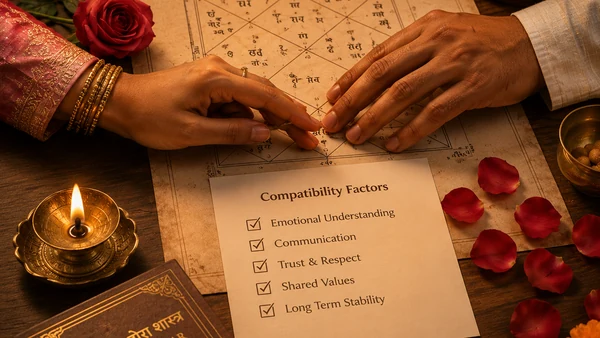
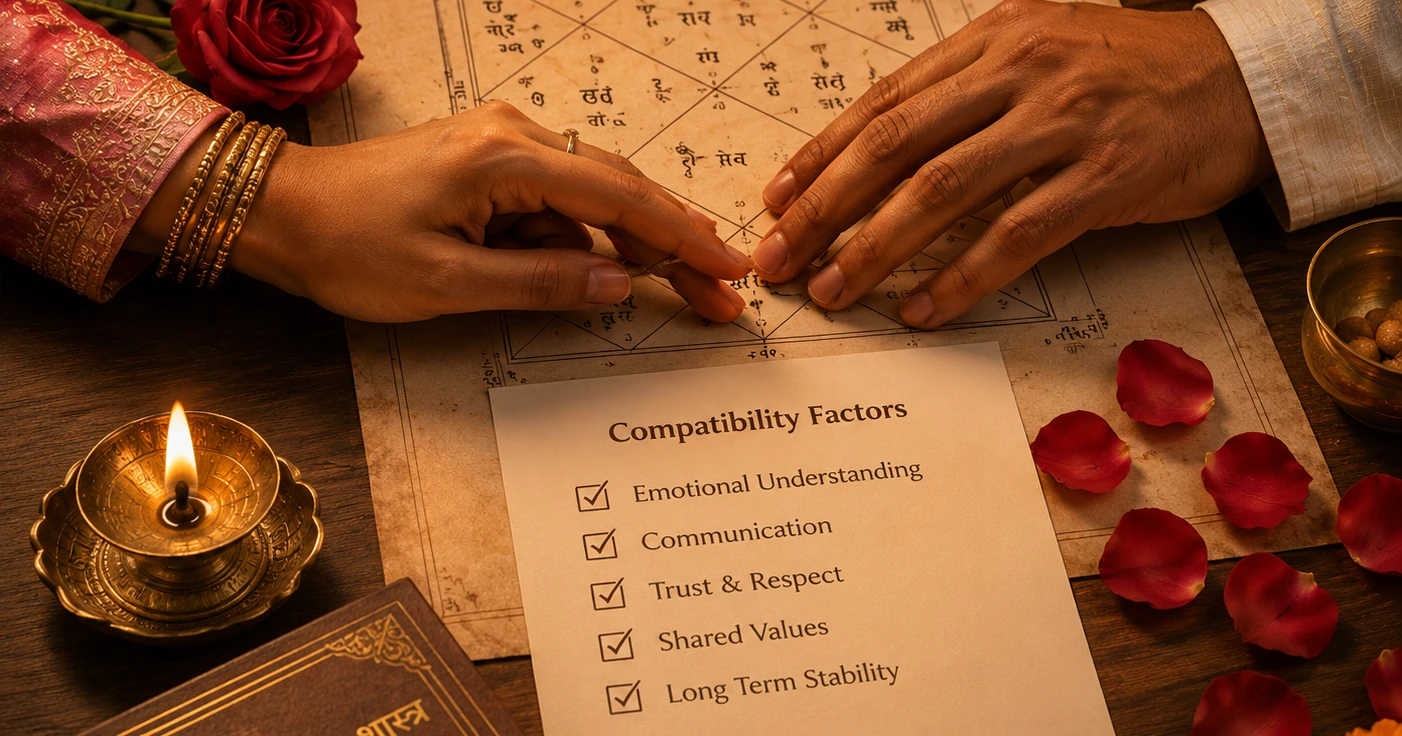
Reading one birth chart tells only half the story. Marriage involves two people. That's why astrologers also compare both Kundlis together — a process commonly known as Kundli Matching.
Many people only know about the famous "36 Gun Milan." But experienced astrologers usually examine much more than a final score. They may study:
- Emotional compatibility
- Communication style
- Long-term stability
- Shared values
- Strengths and possible challenges
Sometimes a couple has an average Gun Milan score but strong overall compatibility. Sometimes the score looks impressive while other important relationship indicators need attention.
The goal is understanding compatibility — not chasing a perfect number.
Many families reject a match after hearing only the Gun Milan score. A complete compatibility analysis always provides more useful information than a single number.
Quick Compatibility Check
Answer one quick question — no birth details needed.
Has a Kundli matching already been done for you?
Can You Read Your Own Kundli?
Yes. You can definitely understand the basics.
Learning about houses, planets, and marriage indicators helps you ask better questions and avoid common myths.
However, interpreting a complete chart is different from identifying individual placements. Astrology works by connecting many pieces together — looking at one isolated factor often creates confusion.
Learning the basics is valuable. Drawing final conclusions from a single rule usually isn't.
- Did I study the complete chart?
- Did I check more than one planet?
- Did I understand the 7th house and its ruler?
- Did I consider marriage timing?
- Did I compare both Kundlis if a partner is involved?
If the answer is "no" to most of these questions, there probably isn't enough information to make a reliable conclusion yet.
When Should You Consider a Detailed Marriage Analysis?
Not every situation requires a detailed report. But many people find it helpful when:
- Marriage discussions keep getting delayed
- Multiple proposals don't move forward
- Families receive different opinions from different astrologers
- You want to understand compatibility with one specific person
- You want clarity before making an important relationship decision
The purpose isn't to create fear. It's to understand your chart with more context than isolated online advice can provide.