When two people plan to get married, one of the first things many families ask is: "Kitne Gun mile?"
Some people believe 36 out of 36 means a perfect marriage. Others think anything below 18 means the marriage should not happen.
The truth is much more practical.
- Kundli Matching checks compatibility — it doesn't predict success or failure
- Gun Milan is one part of the process, not the entire decision
- The 8 Koot system scores different areas of married life, out of 36 total
- A score alone never tells the full story — the complete chart matters more
What Is Kundli Matching?
Kundli Matching is not about predicting whether a marriage will succeed or fail.
It is a traditional way of checking how two birth charts compare in important areas of married life. It looks at compatibility, not certainty.
Gun Milan is one part of the process — not the entire decision.
यही सबसे बड़ी गलतफहमी है। बहुत लोग Gun Milan को पूरी Kundli Matching समझ लेते हैं, जबकि यह उसका सिर्फ एक हिस्सा है।
Why Do Families Check Kundli Matching?
Marriage is one of the biggest life decisions. Families want to understand whether two people are likely to support each other emotionally, mentally and practically.
That is why Kundli Matching has been followed for generations. A proper comparison may help identify:
- General compatibility
- Emotional understanding
- Lifestyle differences
- Family adjustment
- Long-term harmony
- Areas that may need extra attention
It is not meant to create fear. Instead, it helps people understand the relationship more clearly.
Kundli Matching is meant to support better decision-making. It should never replace communication, trust, respect and understanding between two people.
What Is Gun Milan?
Gun Milan is the most well-known part of Kundli Matching. It compares the birth charts of two people using eight compatibility factors, known as Ashta Koot Milan.
Each factor checks a different area of compatibility. Together they add up to 36 points, which is why many people simply call it 36 Gun Milan.
The final score gives a broad idea of compatibility. But the score alone never tells the full story.
Does a Higher Score Always Mean a Better Marriage?
Not necessarily. A couple with 34 Gun may still face relationship challenges. Another couple with 22 Gun may enjoy a happy and stable marriage.
Why? Because Gun Milan is only one part of a complete Kundli analysis. An experienced astrologer also studies the 7th House, Venus, Jupiter, marriage timing, planetary strengths, and overall chart balance.
That is why the number should never be viewed in isolation.
36 out of 36 means the marriage is guaranteed to be successful.
No compatibility score can guarantee a successful marriage. Real relationships also depend on communication, mutual respect, emotional maturity and life circumstances.
Understanding the 8 Koot System
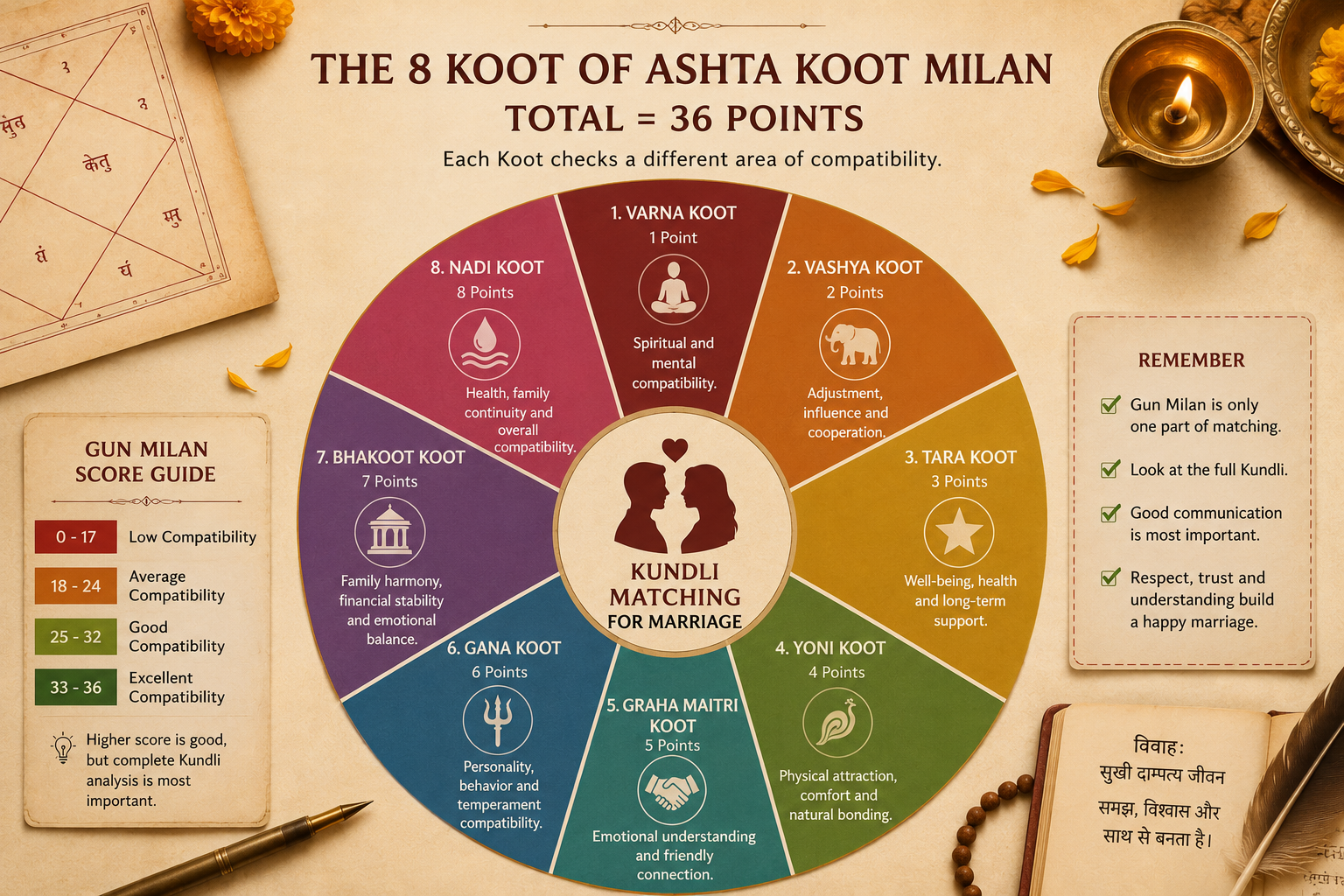
The 36 Gun score comes from eight different compatibility checks. Each Koot focuses on a different aspect of married life. Let's understand them one by one.
1. Varna Koot (1 Point)
Varna Koot looks at spiritual and mental compatibility. It compares how both individuals approach values, learning and personal growth.
It carries only 1 point, so it has the smallest impact on the total score. A lower score here does not automatically create serious marriage problems.
2. Vashya Koot (2 Points)
Vashya Koot studies adjustment and influence in a relationship. It tries to understand whether both partners are likely to cooperate naturally or struggle with control and decision-making.
This is less about dominance and more about balance. Healthy relationships require teamwork, not one person controlling the other.
3. Tara Koot (3 Points)
Tara Koot relates to overall well-being and long-term support. Traditionally, it is associated with health, positivity and mutual growth.
A good Tara score suggests that both charts support each other's progress. It is one small indicator — not a prediction of health or lifespan.
Every Koot measures a different area. No single Koot should decide the entire marriage. Looking only at one factor is like judging a book after reading only one page.
4. Yoni Koot (4 Points)
Yoni Koot represents attraction, comfort and natural compatibility between partners. It reflects how easily two people may connect emotionally and physically.
Many people misunderstand this Koot. It does not make personal judgments about anyone — it simply compares symbolic relationship patterns described in traditional astrology.
5. Graha Maitri Koot (5 Points)
Graha Maitri means friendship between planets. This Koot looks at emotional understanding and mental compatibility.
It helps estimate how comfortably two people may communicate and support each other. Couples who understand each other's thoughts often solve disagreements more easily.
Many people only ask "Kitne Gun mile?" Very few ask "Kaun se Gun kam mile aur kyun?" The second question is usually far more useful — two couples may both score 24 points, but the reasons behind those 24 points can be completely different.
6. Gana Koot (6 Points)
Gana Koot compares personality and behavioural nature. Traditionally, people are grouped into three categories: Deva, Manushya, and Rakshasa.
These names often create unnecessary fear. They do not mean someone is good or bad — they simply describe different personality tendencies.
The purpose is to understand how two temperaments may interact in everyday life. Neither personality is right or wrong; the goal is understanding compatibility, not judging character.
7. Bhakoot Koot (7 Points)
Bhakoot Koot focuses on long-term emotional balance and family life. It studies how the Moon signs of both people interact with each other.
Traditionally, it is linked with family harmony, financial stability, emotional understanding, and long-term relationship growth.
A lower Bhakoot score does not automatically mean a marriage will face problems. Experienced astrologers always check the complete birth chart before drawing conclusions.
8. Nadi Koot (8 Points)
Nadi Koot carries the highest weight in Gun Milan with 8 points. It is traditionally associated with health, family continuity and overall compatibility.
This is also one of the most misunderstood parts of Kundli Matching. Many people become worried the moment they hear "Nadi Dosha."
In reality, experienced astrologers never judge Nadi in isolation. They check many other combinations before deciding whether it is actually significant.
Nadi Dosha ka naam sunte hi darna zaroori nahi hota. Puri Kundli dekhna hamesha zyada important hota hai.
How Is the 36 Gun Score Interpreted?
Many people believe there is a simple pass or fail rule. There isn't. The score only provides a general indication of compatibility.
0–17 Gun
A lower score suggests that the charts may have several compatibility differences. It does not automatically mean marriage should not happen — it simply means the charts deserve a more detailed review.
18–24 Gun
This range is commonly considered acceptable. Many marriages fall within this score. Whether it is suitable depends on the overall Kundli, not just the number.
25–32 Gun
This generally indicates stronger compatibility across multiple areas. Even then, it should not replace a complete chart analysis.
33–36 Gun
This is a high compatibility score. However, it is not a guarantee of a successful marriage. Relationships are built through understanding, communication and mutual effort — not numbers alone.
Imagine two couples. Couple A has 36 Gun, but poor communication, constant misunderstandings, and different life goals. Couple B has 22 Gun, but strong trust, respect, healthy communication, and shared values. Most people would choose Couple B — which is exactly why Gun Milan is only one part of the picture.
Quick Compatibility Check
Answer one quick question — no birth details needed.
Has a Kundli matching already been done for you?
Is 18 Gun Really Enough?
This is one of the most common questions people ask. The honest answer is: sometimes yes, sometimes no. There is no universal rule.
An 18 Gun match may be completely suitable if the 7th House is strong, Venus is well placed, marriage timing is supportive, and no major compatibility concerns appear elsewhere in the chart.
On the other hand, even a 32 Gun match may require careful analysis if other important factors are weak. Every chart is different.
Think of Gun Milan like a health check-up. A blood pressure reading is useful, but no doctor makes a final diagnosis using only one number. Kundli Matching works the same way.
Can a Low Gun Score Still Lead to a Happy Marriage?
Yes. Many happy couples have average or even lower Gun Milan scores.
Why? Because successful marriages depend on many real-life factors such as honest communication, mutual respect, emotional maturity, shared responsibilities, family support, and personal understanding.
Astrology can provide guidance. People still shape the relationship through their choices.
Common Myths About Gun Milan
Only marriages with more than 30 Gun are successful.
Many stable marriages have average scores, while some high-scoring matches still face challenges.
A low Gun score means marriage should be cancelled immediately.
The score is only one part of Kundli Matching. The complete chart always deserves attention.
One Dosha automatically cancels the entire match.
Astrologers study the full chart before reaching any conclusion. One placement alone rarely tells the complete story.
When Gun Milan Should Not Be the Only Decision
This is perhaps the most important part of the entire article. Experienced astrologers never stop after calculating 36 Gun. They also study:
- The 7th House and its strength
- Venus (Shukra) for relationships
- Jupiter (Guru) for guidance and stability
- Marriage timing through planetary periods
- Overall planetary balance
- Individual strengths and challenges in both charts
This creates a much clearer understanding than relying on one compatibility score.
If you've read our guide on how to read a Kundli for marriage, you'll know that every chart is best understood as a complete picture — not a collection of isolated points. And if you're facing repeated delays or relationship concerns, our article on marriage problems in Kundli explains why compatibility scores alone can't answer every question.
- Is the score being explained properly?
- Has the complete Kundli been reviewed?
- Are both individual charts being considered?
- Has marriage timing been checked?
- Do the practical aspects of the relationship also make sense?
If the answer to most of these questions is "no," then the score alone may not give the complete picture.